
What are macronutrients, and what do they actually do?
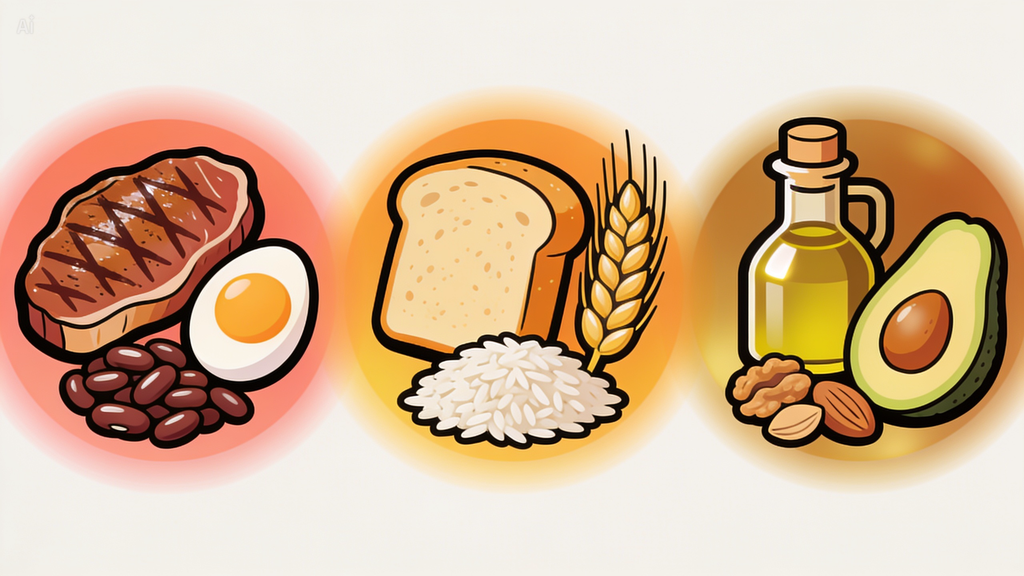
Macronutrients are the three nutrients your body needs in large amounts to function: protein, carbohydrate, and fat. Each one provides energy, measured in kilocalories (kcal), but each also does specific jobs in the body that go well beyond fuel.
What is protein actually made of?
Protein is built from smaller building blocks called amino acids, linked together in chains that fold into specific shapes suited to each protein’s job. There are 20 amino acids the body uses to build protein.
Essential and non-essential amino acids. Of those 20, nine are classed as essential: the body can’t make them itself, so they have to come from food. The rest are non-essential, the body can produce them from other amino acids or compounds, so getting them from food isn’t strictly necessary, though it still happens naturally through normal eating.
What does protein do?
Protein’s best-known role is building and repairing tissue: muscle, skin, and organs all rely on it. But its function extends further. Protein forms enzymes, which drive the chemical reactions that keep the body running, and hormones, which regulate processes like growth and metabolism. It also forms antibodies, part of the immune system’s response to infection, and transport proteins, which carry substances like oxygen and nutrients around the body. Protein provides 4 kcal per gram.
Where to find it: meat, fish, eggs, dairy, beans, lentils, tofu, and other legumes all provide protein.
What public health recommends: the UK Reference Nutrient Intake for protein is 0.75g per kilogram of body weight per day for the average adult, roughly 45 to 55g a day for most people, though individual needs vary with body weight, activity level, and life stage.
What is carbohydrate actually made of?
Carbohydrate is built from sugar units. Simple carbohydrates are single sugar units (like glucose or fructose) or pairs of them joined together (like sucrose, table sugar). Complex carbohydrates, mainly starches, are long chains of these sugar units linked together, found in foods like grains, potatoes, and legumes. Dietary fibre is also a carbohydrate, but one the body can’t fully digest, which is exactly why it behaves differently in the gut.
Wholegrain versus refined, and blood sugar. A whole grain keeps all three original parts of the grain: the bran and germ (which carry fibre, vitamins, and minerals) alongside the starchy endosperm. Refining removes the bran and germ, leaving mostly the starchy endosperm behind. This matters for digestion speed: refined carbohydrates are broken down and absorbed faster, producing a quicker, larger rise in blood glucose. Wholegrain versions digest more slowly, largely because of their fibre content, producing a more gradual rise.
What does carbohydrate do?
Carbohydrate is the body’s preferred, fastest-access energy source, and the main fuel the brain runs on. Once broken down into glucose, carbohydrate is either used immediately for energy or stored as glycogen in the liver and muscles for later use. Carbohydrate provides 4 kcal per gram.
Where to find it: bread, rice, pasta, potatoes, oats, fruit, and vegetables all provide carbohydrate, alongside naturally occurring or added sugars in many foods.
What public health recommends: SACN’s guidance sets carbohydrate at around 50% of total dietary energy, with free sugars kept under 5% of energy. UK guidance also recommends around 30g of fibre a day, most people currently eat considerably less than this.
What is fat actually made of?
Fat molecules are built from fatty acid chains attached to a backbone called glycerol, together forming a triglyceride. The structure of the fatty acid chain determines whether it’s saturated (no double bonds between carbon atoms, generally solid at room temperature, found more in animal fats) or unsaturated (one or more double bonds, generally liquid at room temperature, found more in plant oils and oily fish).
Two fatty acids, omega-3 (alpha-linolenic acid) and omega-6 (linoleic acid), are essential in exactly the same way the nine essential amino acids are: the body can’t make them, so they have to come from food.
What does fat do?
Fat supports the structure of every cell membrane in the body, and is a building block for hormone production. It also enables the absorption of fat-soluble vitamins, A, D, E, and K, which the body can’t absorb properly without dietary fat present. Fat provides long-term energy storage and 9 kcal per gram, more than double protein or carbohydrate, a function of its chemical structure, not a reason to avoid it.
Where to find it: oily fish, nuts, seeds, avocado, and olive oil provide unsaturated fat; butter, cheese, and fatty cuts of meat provide more saturated fat.
What public health recommends: UK guidance sets total fat at around 35% of food energy, with saturated fat kept to no more than 11% of food energy.
Putting it on your plate
None of these figures are targets to hit perfectly every day, they’re population-level averages intended to guide overall balance over time, not individual prescriptions. The NHS Eatwell Guide translates these proportions into a visual plate model: roughly a third fruit and vegetables, just over a third starchy carbohydrates (choosing higher-fibre, wholegrain versions where possible), some protein foods, some dairy or dairy alternatives, and a small amount of unsaturated fat.
If you want to know what any of this means for you specifically, given your own health, activity level, or medical history, that’s exactly the kind of thing worth discussing with a registered dietitian, general information like this can’t account for individual circumstances.
This content is for educational and informational purposes only and does not substitute for professional medical advice, diagnosis, or treatment.