
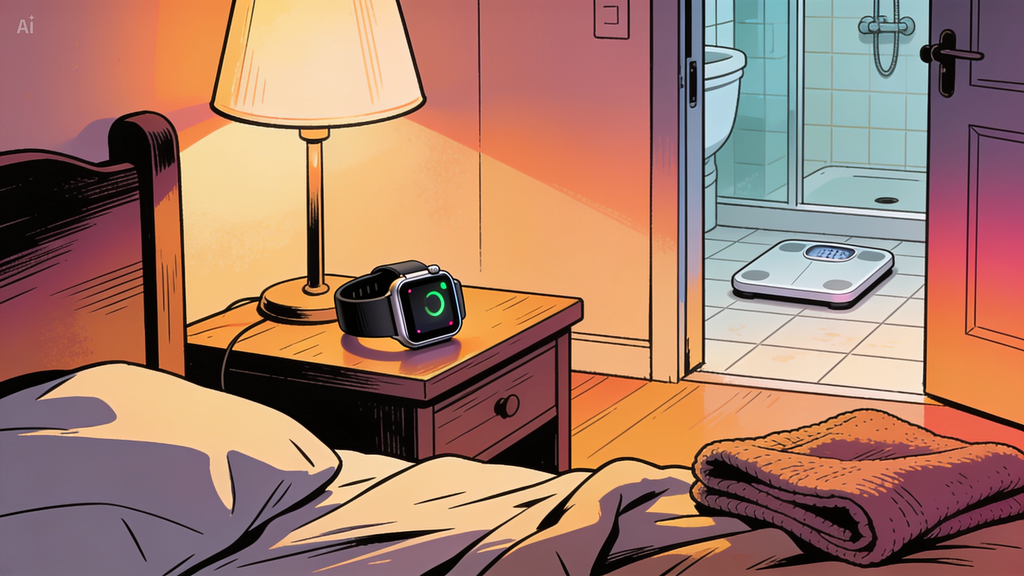
Continuous glucose monitors, smart scales, home blood pressure cuffs, sleep trackers, heart rate watches. Ten years ago, most of these lived in clinics. Now they sit on your wrist, your bathroom floor, or your bedside table, and many people without any diagnosed condition use them daily out of curiosity, for general health, or for nutrition insight.
The assumption behind most of this technology is that it simply reports what’s already true about your body. Numbers in, information out, nothing added. A growing body of published research suggests that assumption doesn’t quite hold up. These devices don’t only describe your body. For some people, they appear to shape how they feel about it too, sometimes reassuringly, sometimes less so. Nothing here is definitive or true for everyone who uses one. What the evidence does show is a consistent, worth-noticing pattern of potential emotional impact, not a universal effect and not a reason to avoid these tools.
What the research on glucose monitors shows
Continuous glucose monitoring (CGM) is a wearable sensor that tracks glucose levels throughout the day. It has an established, well-evidenced role in diabetes care. What’s less settled is what happens psychologically when someone without a clinical need for it uses one out of curiosity, and research suggests no agreed standard yet exists for interpreting readings outside diagnosed diabetes.
A 2025 mixed-methods study of 56 adults using CGM for lifestyle change, published in Obesity Research and Clinical Practice, found that perceived dietary and physical activity benefit could sit alongside distress, fear, and uncertainty about what the readings actually meant, often in the same person: more than two-thirds of participants reported fear specifically when they saw a high glucose reading, and younger adults and those with obesity reported the most distress. That pairing isn’t limited to lifestyle users either. A qualitative meta-synthesis of people with type 1 diabetes described CGM as functioning as both “best friend” and “spy”, capturing how the same device could feel supportive and surveillance-like depending on the moment. Separate qualitative research in adults with type 1 diabetes using flash glucose monitoring found the technology could influence what, why, when, and how much people ate, alongside a reported sense of continual scrutiny from the data.
Taken together, this suggests the coexistence of reassurance and worry isn’t unique to any one glucose-monitoring population. It shows up whether or not a clinical target exists, which points toward something about the technology and how it’s interpreted, rather than the glucose readings themselves.
A similar pattern turns up with other devices
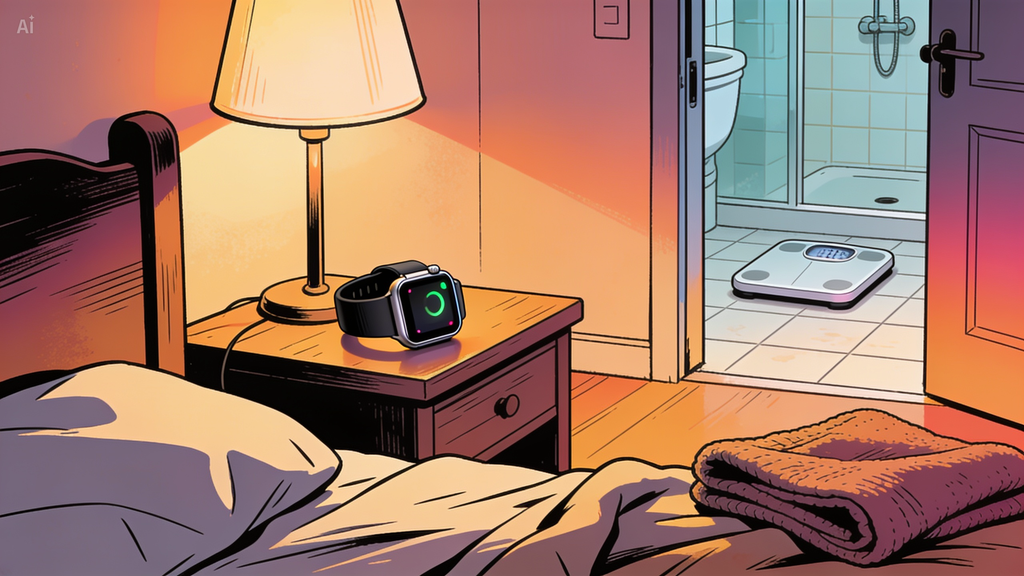
CGM doesn’t sit in isolation. It’s one part of a much wider shift toward self-tracking health technology, and the published research on other devices tells a strikingly similar story.
Sleep trackers can be associated with a phenomenon researchers now call orthosomnia, an unhealthy preoccupation with achieving “perfect” sleep as defined by the device rather than by how rested someone actually feels. A 2024 cross-sectional study of 523 adults found that between 3% and 14% met criteria for orthosomnia depending on how strictly it was measured, and that those who did were consistently more likely to report insomnia symptoms than those who didn’t.
Home blood pressure monitoring shows a comparable push and pull for some users. A 2023 systematic review of 35 qualitative studies in the American Journal of Hypertension found that people often valued the sense of control and reassurance that came from monitoring their own readings, while also describing “anxiety and panic over bad numbers” and the device becoming, for some, a constant reminder of illness. Uncertainty about whether a reading counted as normal appeared to make that worse, particularly when no one had explained what the numbers meant.
Bathroom scales offer a more cautionary version of the same pattern. A narrative review of twenty studies on self-weighing found a negative relationship with self-esteem in most of the studies that measured it, and a negative relationship with mood and body evaluation in a substantial minority, more often in women and younger people specifically. The exception tended to be people already in structured, supported weight management, where the numbers had context and purpose rather than existing on their own.
Wearable heart rate and fitness trackers have generated their own proposed term: techno-hypochondria, put forward in 2026 by nursing researchers to describe an excessive, decontextualised focus on biometric data that can lead someone to misread an ordinary fluctuation, a slightly elevated heart rate, an unusual sleep score, as evidence that something is wrong. The concept comes from analysing existing literature on healthcare professionals specifically, not new data from the general public, so it’s best read as a plausible, theory-stage framework rather than a confirmed effect in wearable users generally. It’s included here because the pattern it describes lines up closely with what the CGM, blood pressure, and sleep-tracking research above shows across quite different groups of people.
Why a similar pattern keeps turning up
Across five different devices measuring five different things, a similar duality keeps appearing: reassurance and anxiety, awareness and vigilance, showing up together rather than one simply replacing the other for a given person. That’s unlikely to be coincidence, and it doesn’t seem to be about glucose, or blood pressure, or sleep stages specifically.
The sociologist Deborah Lupton, writing on the broader rise of self-tracking technology, argues that quantified personal data doesn’t carry meaning on its own. It acquires meaning through the context a person brings to it and the interpretation available to them. A number without context is just a number. Handed to someone with no frame of reference for what’s normal, that same number can become something to worry about instead.
There’s some support for this in the CGM literature specifically. A small pilot study of 15 adults with prediabetes paired CGM with structured low-carbohydrate dietary coaching and found high satisfaction alongside modest improvements in weight and blood glucose control, in a group whose readings came with guided interpretation rather than the device alone. It’s a small, single-arm study, not proof that guidance resolves the anxiety side of the pattern, but it’s a reasonable indication that context and interpretive support may matter as much as access to the data itself.
What this means if you use one of these devices
None of this is an argument against health tracking technology, and it isn’t a suggestion that people with a genuine clinical need for glucose, blood pressure, or sleep monitoring should stop. For many people, these tools are useful, and usefulness and unease aren’t mutually exclusive. They can both be true for the same person on the same day, and plenty of people use these devices without any notable emotional impact at all.
What the evidence does suggest is that the number on the screen is unlikely to be the whole story, and that any emotional response you have to it is worth paying attention to in its own right, separate from whatever the number is technically telling you. If you don’t have a clear sense of what your own readings mean for you specifically, that gap in understanding may be doing more of the work than the numbers themselves.
If a device has ever left you feeling more anxious than informed, that’s a recognised pattern in the research, not something unusual to you.
References
Jahrami, H., Trabelsi, K., Husain, W., Ammar, A., BaHammam, A.S., Pandi-Perumal, S.R., Saif, Z. and Vitiello, M.V. (2024) ‘Prevalence of orthosomnia in a general population sample: a cross-sectional study’, Brain Sciences, 14(11), 1123. doi: 10.3390/brainsci14111123.
Klonoff, D.C., Nguyen, K.T., Xu, N.Y., Gutierrez, A., Espinoza, J.C. and Vidmar, A.P. (2023) ‘Use of continuous glucose monitors by people without diabetes: an idea whose time has come?’, Journal of Diabetes Science and Technology, 17(6), pp. 1686-1697. doi: 10.1177/19322968221110830.
Lupton, D. (2016) The Quantified Self: A Sociology of Self-Tracking. Cambridge: Polity Press.
Messer, L.H., Johnson, R., Driscoll, K.A. and Jones, J. (2018) ‘Best friend or spy: a qualitative meta-synthesis on the impact of continuous glucose monitoring on life with type 1 diabetes’, Diabetic Medicine, 35(4), pp. 409-418. doi: 10.1111/dme.13568.
Natale, P., Ni, J.Y., Martinez-Martin, D., Kelly, A., Chow, C.K., Thiagalingam, A., Caillaud, C., Eggleton, B., Scholes-Robertson, N., Craig, J.C., Strippoli, G.F.M. and Jaure, A. (2023) ‘Perspectives and experiences of self-monitoring of blood pressure among patients with hypertension: a systematic review of qualitative studies’, American Journal of Hypertension, 36(7), pp. 372-384. doi: 10.1093/ajh/hpad021.
Pacanowski, C.R., Linde, J.A. and Neumark-Sztainer, D. (2015) ‘Self-weighing: helpful or harmful for psychological well-being? A review of the literature’, Current Obesity Reports, 4(1), pp. 65-72. doi: 10.1007/s13679-015-0142-2.
Richardson, K.M., Jospe, M.R., Somerville, J., Felrice, J. and Schembre, S.M. (2025) ‘Understanding the benefits and psychological burdens of using continuous glucose monitoring for lifestyle change: a mixed-methods cross-sectional study’, Obesity Research and Clinical Practice, 19(5), pp. 417-426. doi: 10.1016/j.orcp.2025.10.003.
Celik Durmus, S. (2026) ‘Techno-hypochondria: a concept analysis of wearable technology-induced health anxiety among healthcare professionals, implications for nursing management’, Healthcare, 14(13), 1971. doi: 10.3390/healthcare14131971.
Wallace, T., Heath, J. and Koebbel, C. (2023) ‘The impact of flash glucose monitoring on adults with type 1 diabetes’ eating habits and relationship with food’, Diabetes Research and Clinical Practice, 196, 110230. doi: 10.1016/j.diabres.2022.110230.
Yost, O., DeJonckheere, M., Stonebraker, S., Ling, G., Buis, L., Pop-Busui, R., Kim, N., Mizokami-Stout, K. and Richardson, C. (2020) ‘Continuous glucose monitoring with low-carbohydrate diet coaching in adults with prediabetes: mixed methods pilot study’, JMIR Diabetes, 5(4), e21551. doi: 10.2196/21551.
This content is for educational and informational purposes only and does not substitute for professional medical advice, diagnosis, or treatment.